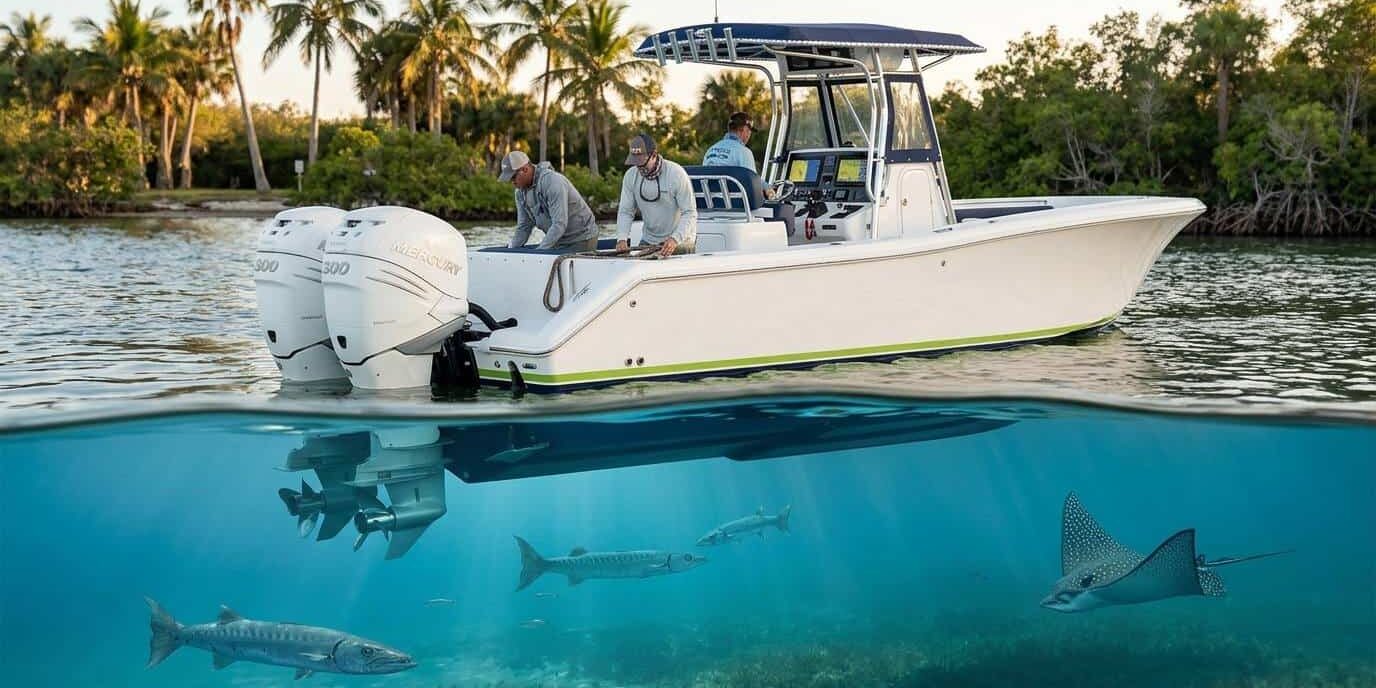
How do you value a used boat?
Knowing how to value a used boat starts with sold prices: what the same make, model and year actually closed at over the last 12 to 24 months. Then adjust for six factors: brand and model, engines, condition, records, equipment and hull history. On a 34 foot cruiser, asking and sold prices can sit $40,000 apart.
- $40,000Possible gap between asking and sold prices for the same 34 foot cruiser model year.
- 50 to 100 hoursEngine hours a year that most buyers read as normal use.
- 5.1%Gain in used outboard boat values in 2025, per J.D. Power, while stern drives fell 2.5%.
- $18 to $25 per footTypical marine survey fee according to J.D. Power, while our sold data valuation is free.
Most owners price a used boat from what they paid, what they’ve spent since and what a similar boat down the dock is asking, and buyers ignore all three. To learn how to value a used boat the way the market does, start with what comparable boats actually closed at, then adjust for the six factors that move the price.
Our licensed brokers at Manatee Pocket Yacht Sales in Stuart, Florida run this process on every boat we price. Here are the six factors, with the thresholds buyers and surveyors actually use.
Asking prices float. Sold prices sit at the waterline.
On a 34 foot cruiser, the two can sit $40,000 apart for the same model year. A real valuation starts where boats actually closed.
Key Takeaways
- A used boat’s value comes from what comparable boats recently closed at. On a 34 foot cruiser, asking and sold prices for the same model year can sit $40,000 apart.
- Brand, model and power type set the ceiling. Engines, condition, records, equipment and hull history decide where your boat lands below it.
- Buyers read roughly 50 to 100 engine hours a year as normal use, and suspiciously low hours raise questions too.
- Upgrades rarely return their cost, and electronics older than about seven or eight years add little.
- A broker valuation from sold data is free with us. A marine survey typically runs $18 to $25 per foot, according to J.D. Power.
How Do You Value a Used Boat? Start With Sold Comparables
You value a used boat by finding what boats of the same make, model, year and power package actually closed at over the last 12 to 24 months, then adjusting that range for six factors. Asking prices and a boat pricing guide such as J.D. Power (formerly NADA) give you a starting point, not a valuation.
Brokers call those closed sales sold comparables, or comps. Ours come from SoldBoats.com, the industry database of what boats actually sold for, which isn’t open to the public, while YachtWorld and Boat Trader only show what sellers hope to get.
When we pull sold comparables for a listing, the gap between asking and closing prices is the first thing owners argue about. On a 34 foot cruiser, that spread can reach $40,000 for the same model year, and it’s exactly where boats sit unsold for 18 months.
Why Price Guides Only Get You Close
Discover Boating, the consumer site of the National Marine Manufacturers Association (NMMA), notes in its overview of boat pricing guides that the major guides each use a different method, so one boat can show different numbers in each. Every used boat value tool also averages a whole model year, so none can see your engines or your boat’s history.
 For the full method from comps to list priceRead how brokers actually value a boat
Factor 1: Brand, Model and Power Type Set the Ceiling
Brand, model, model year and power type set the ceiling on a used boat’s value, because they decide how many buyers are shopping for it. Popular saltwater outboard boats from builders like Grady-White, Regulator and Boston Whaler resell into a deep buyer pool, while discontinued or niche models sell to fewer buyers for less.
According to J.D. Power, most used boats lose about 10% to 20% of their value after one year, 20% to 30% after five years and 30% to 40% after ten, and past that point condition and upkeep matter more than the calendar.
Power type moves value too. J.D. Power’s 2025 year end marine report found used outboard boats from the latest ten model years brought 5.1% more than a year earlier, while stern drives brought 2.5% less. Its second quarter 2026 report describes used boat prices as stable to increasing across most segments, with outboards leading demand.
- Outboard boats up 5.1%
- Stern drives down 2.5%
Model matters as much as brand. A Boston Whaler Outrage and a Boston Whaler Vantage share a builder but not a buyer, so center consoles only get compared with center consoles. Scroll through the boats we’ve sold recently and you’ll see the same brands and models again and again.
Factor 2: Engines, Hours and Repowers
Engines are usually the biggest single swing in a used boat’s value, because replacing them can cost a large share of what the boat is worth. Buyers read roughly 50 to 100 hours a year as normal use, then weigh total hours against engine type, service history and how much life is left.
Engine type changes what counts as high hours. These commonly cited rules of thumb assume good maintenance and aren’t guarantees:
| Engine type | Typical life with good care | Hours that draw buyer questions |
|---|---|---|
| Four stroke outboard | 1,500 to 3,000 hours | Above about 1,500 |
| Older two stroke outboard | 750 to 1,500 hours | Above about 700 |
| Gas inboard or sterndrive | 1,000 to 2,000 hours | Above about 1,000 |
| Diesel inboard | 5,000 to 8,000 hours | Above 3,000 to 5,000 without overhaul records |
- Under 50 a year: ask whether it sat
- 50 to 100 a year: normal use
- Above 100 a year: heavier use
Picture a 2016 30 foot center console with twin 300s and 1,100 hours. That’s about 110 hours a year, close to normal. At 2,200 hours the same boat drops to the bottom of its comps, because every buyer prices in a repower.
Why Low Hours and Repowers Surprise Sellers
After enough surveys you learn that an engine that sat can be in worse shape than one that ran. A 10 year old boat showing 150 hours raises questions about stale fuel, dried out seals and corrosion.
A repower cuts the other way: new engines rarely add their full cost back, but they widen the buyer pool and shorten time on the market.
Factor 3: Condition and What the Marine Survey Will Find
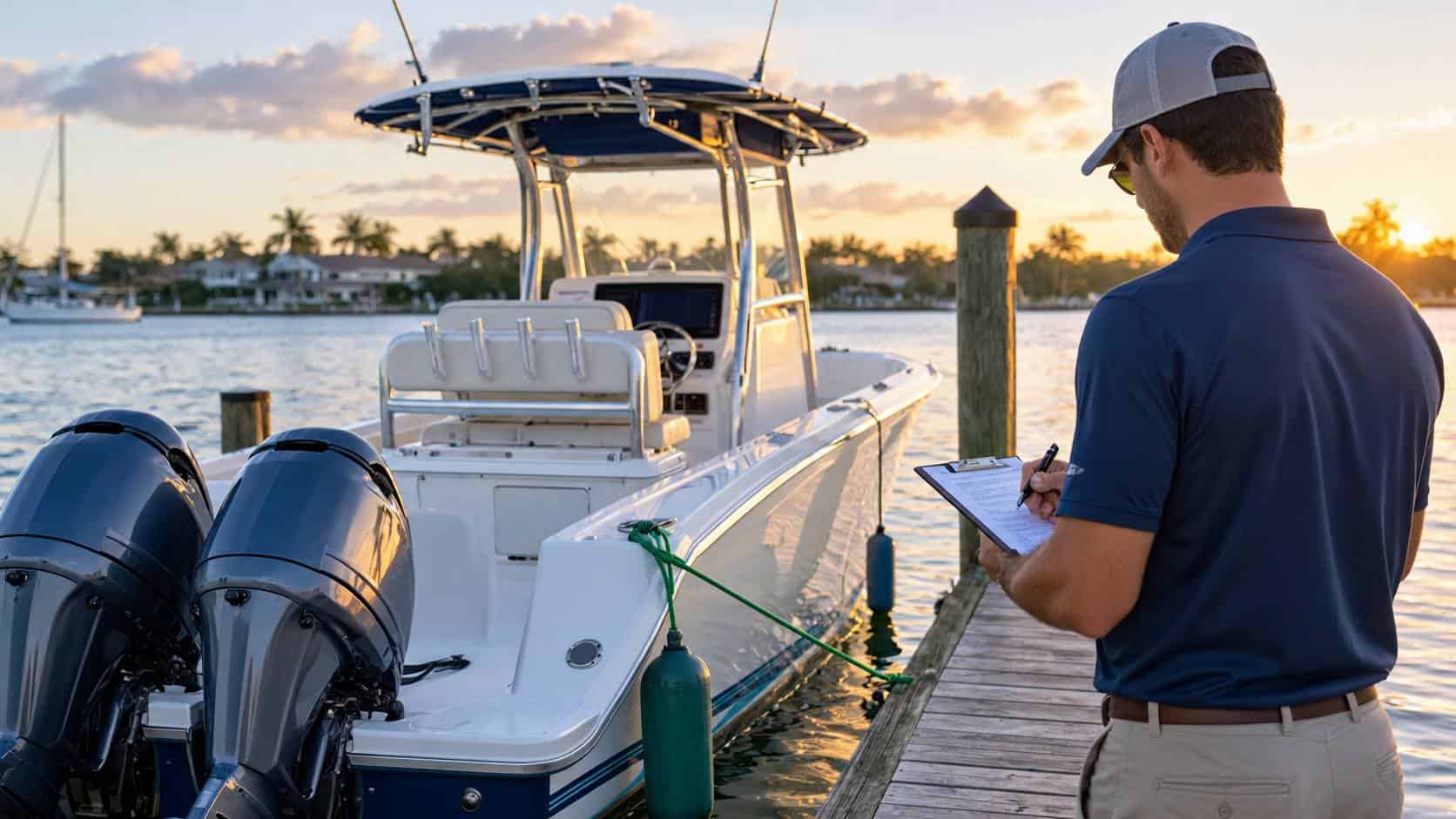
Condition decides where a used boat’s value lands inside its sold range, and the marine survey is where condition gets priced. Buyers renegotiate on what the surveyor finds, so a problem you knew about and didn’t price in usually costs more at survey than disclosing or fixing it up front would have.
A marine survey is an independent inspection of the hull, deck, structure, engines and systems, usually with a haul out, and a sea trial is the test run under load. J.D. Power puts typical surveyor fees at $18 to $25 per foot, or roughly $540 to $750 for a 30 foot boat before haul out charges.
What Surveyors Flag Most Often
- Moisture or delamination in the deck, transom or stringers.
- Blisters, cracks or old repairs below the waterline.
- Wiring added over the years without a plan, and corroded connections.
- Engines that won’t reach the manufacturer’s rated wide open throttle RPM.

On sea trials out of the St. Lucie Inlet, our brokers see it constantly: a boat that runs cool, reaches its rated RPM and stays dry when a northeast wind stacks up the inlet earns a stronger offer than a fancier boat that doesn’t. Nick Williams, one of our brokers, holds a 100 ton master’s license and runs boats between Florida, the Keys and the Bahamas. Every broker on our team owns or has run boats on this coast.
On an older or higher value boat, a survey before listing finds surprises on your schedule, and we can point you to surveyors and service partners on the Treasure Coast.
Factor 4: Maintenance Records and Clean Paperwork
Maintenance records turn a seller’s claims into evidence, and buyers pay for evidence. A binder of service invoices with engine hours noted, past surveys and repower paperwork answers the surveyor’s questions before they come up, while gaps in the history usually get priced as if the worst happened in them.
Most outboard makers set a basic service interval around 100 hours or once a year, so buyers can check invoices against the hour meter in minutes. Pull these together now:
- Engine service invoices showing date, hours and work done.
- Bottom paint dates and haul out or yard invoices.
- Prior surveys, especially the one from your purchase.
- Repower, warranty and electronics receipts.
- Your Florida title and registration from the Florida Department of Highway Safety and Motor Vehicles (FLHSMV), or your Certificate of Documentation from the U.S. Coast Guard National Vessel Documentation Center, plus any lien release.
Paperwork gaps slow the closing and give a buyer time to cool off.
If you want to know where your boat actually sits against sold data, we’ll run the comparables for free through our valuation service.
Factor 5: Electronics, Equipment and Upgrades
Equipment adds less to a used boat’s value than most owners expect, because buyers pay for what works and what’s current, not for what it cost. In our experience, electronics older than about seven or eight years get little credit, while working basics like bilge pumps, air conditioning, the generator and charging systems protect value far more than extras.
A $25,000 electronics package doesn’t add $25,000 to the sale price, and buyers know it. What helps is equipment a buyer would otherwise buy right away.
Buyers give credit for
- Current chartplotters under warranty
- Fresh canvas
- A gyro stabilizer on a larger boat
- Working pumps, air conditioning, generator and charging
Buyers give little credit for
- Electronics older than about seven or eight years
- What a package originally cost you
Sailboats add their own line. Sails, standing rigging and the auxiliary diesel often matter more to a sailboat buyer than electronics, and many surveyors and insurers ask questions once standing rigging passes about 10 to 15 years. If you’re comparing used sailboats for sale in Florida, check sail and rigging age before price.
Factor 6: Hull History and Where the Boat Lived
Where a boat lived and what happened to it can move a used boat’s value more than its age. A hull kept on a lift or in dry storage usually surveys cleaner below the waterline than one left in the water year round, and storm damage, a sinking or an insurance total loss surfaces at survey and gets discounted heavily.
Storage shows up fast on this coast. A hull that has sat in the Indian River without a lift tells a different story at haul out than the same model kept on a lift in Sewalls Point, and surveyors look for exactly that: heavy growth, blisters, worn running gear and tired through hull fittings.
Storm history needs a plan, not silence. Hurricane season runs from June 1 to November 30, according to the NOAA National Hurricane Center, and a storm damaged boat can still sell well when yard invoices and a clean survey back up the repair. An unexplained repair with no paperwork gets priced as a risk.
Where the boat sits today matters far less: the buyer for a Stuart boat is often not in Stuart, so the national market sets your used boat’s value.
Putting the 6 Factors Together: An Illustrative Used Boat Valuation
Applied together, the six factors turn a sold range into a realistic number for one specific boat. A boat with normal hours, a clean survey history and full records sits in the upper half of its comps, while high hours, missing paperwork or storm damage push it toward the bottom.
Picture a 28 foot center console from 2018 with twin 250s, and say comparable boats closed between $110,000 and $135,000 over the last 18 months (illustrative numbers, not a real report).
- Comparable sales: $110,000 to $135,000
- Expected sale range: $118,000 to $126,000
- List price: a little above the expected range
- Priced off listings at $145,000: the boat sits
- HoldsBrand and model: a popular model with plenty of comps, so the range holds.
- LowerEngines: 1,050 hours over eight seasons, about 130 a year, nudges it below the middle.
- HoldsCondition: a dry deck and clean bottom at the last haul out keep it there.
- SupportsRecords: full invoices from one shop make the hours believable.
- NeutralEquipment: original 2018 electronics add little.
- SupportsHistory: kept on a lift with no storm claims, which supports the number.
Net result: an expected sale range of roughly $118,000 to $126,000, with a list price a little above it to leave room to negotiate. Priced off listings at, say, $145,000, the same boat would sit.
A 5 Step Self Check to Value a Used Boat Today
You can build a realistic range for your own boat in about 30 minutes with your paperwork and an honest eye. These five steps won’t replace sold data, but they’ll tell you whether the number in your head holds up before you talk to a broker, a buyer or a seller.
- Write down the make, model, year, hull identification number (HIN) and engine hours.
- Note the low and average retail figures from a boat pricing guide such as J.D. Power.
- Find three to five similar boats for sale and note how long each has sat. In our experience, a boat listed more than six months is usually overpriced, not undervalued.
- Score your boat honestly on the six factors above, the way a surveyor would.
- Subtract anything broken or overdue, then compare your used boat value with a broker’s sold data figure and ask to see the comps.
That’s the practical answer to how to work out a boat value before anyone runs comps: know what buyers check, and have the proof ready.
Buying Instead of Selling?
The same six factors tell you whether an asking price is fair. Because the seller pays the commission on a brokerage sale, you can have a broker search for you at no cost, including boats not yet on the open market.
When an Online Guide Is Good Enough
Not every used boat valuation needs a broker. For a small, common trailer boat worth, say, under $15,000, a J.D. Power lookup plus a scan of local listings gets you close, and selling it yourself may net more because commission would eat much of what a broker adds. The same goes for owners happy to handle showings, screening and title paperwork themselves.
Common Mistakes When Valuing a Used Boat
The costliest mistakes when valuing a used boat are starting from what you paid, comparing across boat types, paying for big repairs right before listing and pricing high to leave room. Each one pushes the number above what buyers will pay, and a boat that goes stale usually sells for less than a realistic day one price would have brought.
- Starting from your purchase price. The market doesn’t care what you paid.
- Comparing across boat types. An express cruiser and a center console of the same length sell to different buyers.
- Paying for major mechanical work right before listing. A deep clean, bottom paint if due and working electronics usually return more than they cost, but major mechanical work rarely does, because buyers discount for it either way and the survey will find it.
- Pricing high to leave room. A pattern we see on listings that come to us after a year with another broker: priced high to win the listing, then stale. We’d rather lose a listing than take one at a price we know won’t sell.
Get a Sold Data Valuation for Your Boat
The most dependable shortcut for how to value a used boat is a licensed broker pulling sold comparables from the last 12 to 24 months for your exact boat and adjusting them honestly for the six factors above. That costs nothing, and you get back a list price, an expected sale range and a realistic timeline for the season.
Tell us about your boat and we’ll send a free valuation built from real sold data, along with the comparable sales it came from. There’s no listing fee and nothing owed if you decide not to sell.
Or stop by our office at 4905 SE Dixie Highway, Suite 105, in Stuart.
Frequently Asked Questions
What is the most accurate way to value a used boat?
Compare your boat with what the same make, model, year and power package actually closed at over the last 12 to 24 months, then adjust for engines, condition, records, equipment and hull history. A licensed broker can pull that closing data from SoldBoats.com.
How many engine hours are too many on a used boat?
The answer depends on the engine type. As commonly cited rules of thumb, a well maintained four stroke outboard lasts 1,500 to 3,000 hours, a gas inboard or sterndrive 1,000 to 2,000 hours and a diesel inboard 5,000 to 8,000 hours. Buyers treat 50 to 100 hours a year as normal use, and service records matter more than the number on the meter.
Do upgrades and new electronics add value to a used boat?
Upgrades add some value but rarely their full cost. Buyers credit current, working equipment, while electronics older than about seven or eight years add little.
How much does it cost to get a used boat valued?
A broker valuation built from sold comparables is free with Manatee Pocket Yacht Sales. A marine survey, which lenders and insurers often require, typically costs $18 to $25 per foot according to J.D. Power, plus haul out fees.
If you’d rather go over your boat’s numbers face to face, talk to a Stuart broker at our office or call 772-600-8535.

Tom Whittington
Founder
Manatee Pocket Yacht Sales
Written by our team of licensed Florida yacht brokers · Stuart, Florida · Since 2010
Manatee Pocket Yacht Sales is a licensed Florida yacht brokerage in Stuart, founded by Tom Whittington in 2010. Our ten brokers have closed more than 2,000 boats, including yachts to 76 feet, for owners on the Treasure Coast, across the United States and overseas. We bring pricing from real sold data and buyers screened before they ever step aboard.


Licensed brokers and captains who own and run boats on this coast. Meet the team
- Boat Listing and Selling
- Free Buyer’s Brokerage
- Valuations from Sold Data
- Closing and Documentation
- 2026 Treasure Coast Community’s Choice Awards