
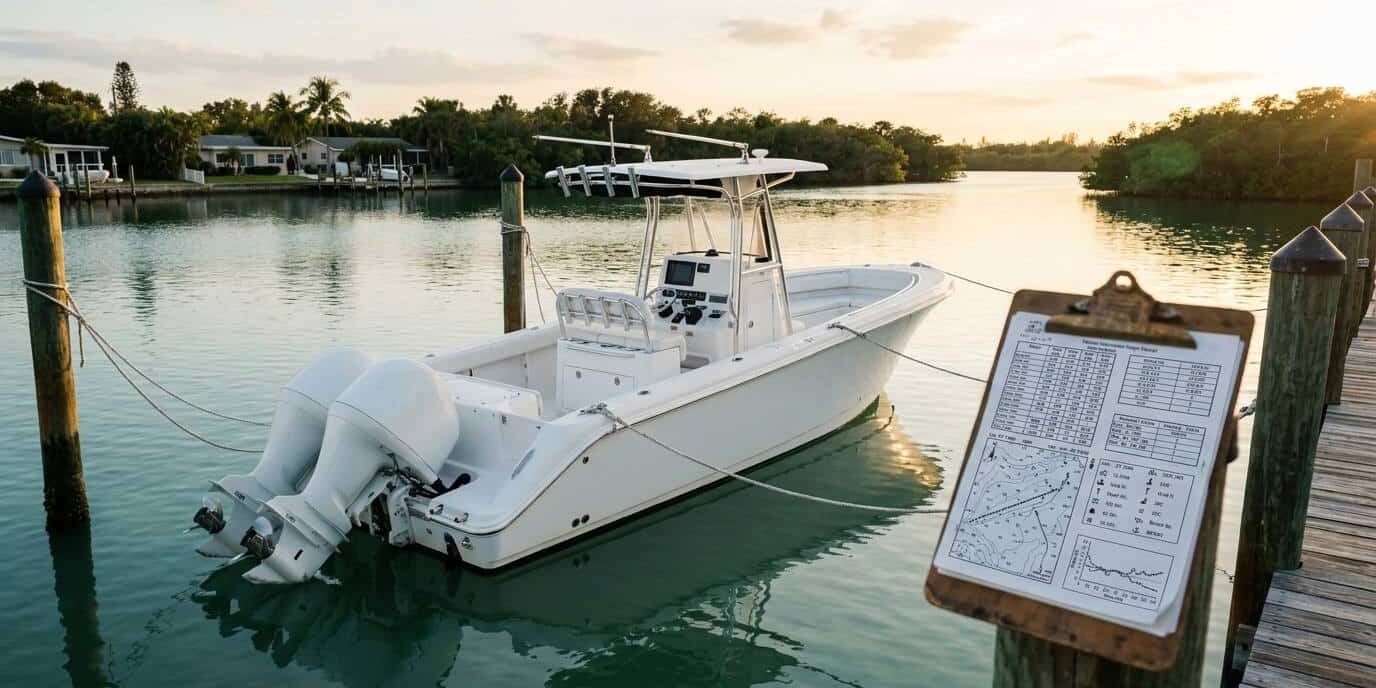
Are NADA boat values accurate?
NADA boat values, now published by J.D. Power, are accurate as a model year average but rarely match what one specific boat will sell for. The guide can’t see engine hours, a repower, condition or storm history. Brokers price from sold data instead, and on a 34 foot cruiser asking and sold prices can sit $40,000 apart.
- 2015J.D. Power bought the NADA Used Car Guide business, and NADA boat values now carry the J.D. Power name.
- 2 figuresA free J.D. Power boat lookup shows low retail and average retail. Suggested list is the original price new.
- $40,000Possible gap between asking and sold prices for the same 34 foot cruiser model year.
- 12 to 24 monthsThe window of closed sales brokers pull from SoldBoats.com to price a boat.
Most owners look up NADA boat values before they ever call a broker, and plenty of them arrive at a listing appointment holding a printout that’s off by tens of thousands of dollars. The guide isn’t broken. It answers a different question than the one you’re asking: what an average example of your model year is worth, not what your boat will close at. Here’s what the number measures, where it misses, and what our brokers at Manatee Pocket Yacht Sales in Stuart, Florida use instead when a real sale is on the line.
Key Takeaways
- NADA boat values now come from J.D. Power, which bought the NADA Used Car Guide business in 2015. The free lookup shows low retail and average retail.
- The guide averages a whole model year, so it can’t see hours, a repower, upkeep or storm history.
- Brokers price from sold comparables: what the same model closed at over the last 12 to 24 months, from SoldBoats.com.
- On a 34 foot cruiser, asking and sold prices for the same model year can sit $40,000 apart.
- Lenders, insurers and dealers still lean on guide values, so the number matters even when it’s wrong for your boat.
Are NADA Boat Values Accurate? The Short Answer
NADA boat values are accurate as a model year average and unreliable as a price for one specific boat. J.D. Power, which publishes the guide today, blends data across a whole make, model and year, so the figure can’t see your hours, a repower, your upkeep or your boat’s history. Use it as a ballpark, then confirm with sold data.
Picture two 2016 30 foot center consoles of the same model, both with twin 300s. One has 900 hours, full records and a lift in Sewalls Point. The other has 2,100 hours, a soft cockpit sole and three summers in the Indian River. The guide gives both the same average retail value. A buyer with a surveyor won’t.
In our experience, a guide lands closest on common 20 to 26 foot outboard boats and drifts furthest on larger yachts and repowered or refit boats, where fewer sales sit behind the average.
What Happened to NADA Guides? J.D. Power Boat Values Explained
NADA Guides didn’t disappear, the name changed. J.D. Power bought the NADA Used Car Guide business in 2015, and the boat values many people still call NADA are now published free on the J.D. Power website. A boat lookup returns a suggested list price plus low retail and average retail figures for the model year you choose.
The NADA name came from the National Automobile Dealers Association, and the guide still serves trade desks, lenders and insurers who need a fast, consistent number.
What Low Retail, Average Retail and Suggested List Mean
J.D. Power notes that its boat figures reflect typical condition ranges for the model.
| Figure | What it reflects | How to use it |
|---|---|---|
| Suggested list price | The original list price when the boat was new | Ignore it for resale. It says nothing about today’s market. |
| Low retail | A rougher example with higher hours, visible wear or work needed | A reference point for a boat that needs attention |
| Average retail | A clean boat with normal wear that needs no major repairs | A ballpark for a well kept boat, before you check sold data |
The free lookup shows nothing above average retail, so an exceptional boat with a recent repower has nowhere to sit in the guide.
Is There a Kelley Blue Book for Boats?
Kelley Blue Book doesn’t value boats, so a search for a boat blue book usually lands on NADA marine values at J.D. Power. BUC International sells a separate paid guide, and the two often disagree on the same boat.
Where NADA Boat Values Get It Wrong
NADA boat values miss what makes one boat different from the average: engine hours and repowers, condition, equipment age, hull and storm history, and the regional market. Those factors can move a real sale price by thousands of dollars on a small boat and by tens of thousands on a larger one, in either direction.
What a price guide sees
- Make, model and model year
- Factory power package and listed options
- A national average for that model
What it can’t see
- Your hour meter, or a repower
- Wet cores, blisters or tired engines
- Electronics age and what actually works
- Lift or water storage, storm history
- Florida demand and the selling season
Engine Hours and Repowers
A guide can’t read your hour meter. Buyers generally treat 50 to 100 hours a year as normal use, so a 2016 boat with 1,100 hours reads as normal, while the same boat at 2,200 hours gets priced as a repower waiting to happen. A recent repower works the other way: it rarely adds back its full cost, but it can lift a boat well above the guide’s average retail.
Condition and Upkeep
Average retail assumes a clean boat that needs nothing major. After enough surveys you learn that buyers renegotiate in the gap between clean and almost clean. A wet deck core, blisters or engines that won’t reach rated wide open throttle RPM all come off the price at survey.
Hull and Storm History
A hull that sat in the Indian River tells a different story at haul out than one kept on a lift, and storm damage surfaces at survey. A guide prices both boats the same.
Region, Season and Thin Data
A national average can’t tell that a boat listed in June competes for a much smaller audience than one listed in October. Large yachts add a second problem: so few change hands each year that the average rests on very little.
For context, J.D. Power’s Q2 2026 marine market report describes used boat values as stable to increasing across most segments, with outboard boats leading demand. Useful context, but it won’t tell you where your boat sits.
How Far Off Can NADA Boat Values Be From a Real Sale?
Far enough to change a pricing decision. A guide figure, an asking price and a sold price are three different numbers for the same boat, and they rarely line up. On a 34 foot cruiser, asking and closing prices for the same model year can sit $40,000 apart, and the guide figure can land above, below or between them.
Picture a 2017 28 foot center console, repowered with twin 250s two seasons ago, with full records and a lift in Jensen Beach.
One boat, three numbers
Guide, listings and closings for the same boat.
- $112,000Guide average retail, which assumes original engines
- $116,000 to $134,000Sold comparables, last 18 months
- $126,000 to $132,000This boat’s expected sale range after adjustments
- $139,000 to $155,000Similar boats listed for sale today
Price that boat at the guide figure and you leave money on the table. Price it off the listings and it sits beside them. Only the sold range measures what buyers actually paid.
From the docksWhen we pull sold comparables for a new listing, the guide, the asking prices and the closings almost never agree. The closings are what a buyer’s broker and surveyor check against, so that’s where we start.
To see how widely closings spread even within one category, look through our recent sold boats and compare the range.
NADA vs BUC vs Sold Data: Which Boat Price Guide Is Most Reliable?
Sold data is the most reliable, because it records what buyers actually paid. J.D. Power (NADA) and BUC are useful boat price guides for a quick range, and lenders and insurers reference them. Asking prices are the least reliable source, because they include every overpriced boat that never sold.
| Source | What it measures | Who can see it | Best use |
|---|---|---|---|
| J.D. Power (NADA) | Model year averages: low and average retail | Anyone, free online | A first ballpark |
| BUC Values | Its own model year estimates | Paid subscribers, mostly professionals | A second opinion on the range |
| Asking prices | What sellers hope to get on YachtWorld and Boat Trader | Anyone | Sizing up your competition |
| SoldBoats.com closings | What boats actually sold for | Brokers and surveyors, not the public | Setting a list price |
| Condition and valuation survey | One surveyor’s view of one boat | Whoever orders it | Financing, insurance and purchase decisions |
To compare the guides yourself, see Discover Boating’s roundup of boat pricing guides from the National Marine Manufacturers Association (NMMA).
SoldBoats.com has limits too. It mostly captures broker reported sales, not private deals, and it doesn’t grade condition. That’s why the adjustment step matters as much as the data.
What Do Yacht Brokers Use Instead of NADA Boat Values?
Brokers use sold comparables: the closing prices of the same make, model, year and power package over the last 12 to 24 months, pulled from SoldBoats.com, the industry database of what boats actually sold for. The broker then adjusts those closings for hours, condition, equipment and history, and checks the live competition before setting a price.
- Identify the boat exactly. Hull identification number (HIN), model year, layout, engines and hours.
- Pull the closings. The same model, usually two model years either side, over the last 12 to 24 months.
- Filter and adjust. Drop different power packages and distressed sales, then adjust for what makes your boat different.
- Check the market and the calendar. Count the competing boats listed today, then price for the season.
The result is a list price, an expected sale range and a walk away floor.

Our founder, Tom Whittington, has closed over 1,500 vessels, serves as President of the Marine Industries Association of the Treasure Coast and sits on the board of the Chapman School of Seamanship, and that volume of closings is what turns a list of comps into a number that holds up at survey.
The full method, step by step
For every step from comps to list price, read how brokers actually value a boat.
Why Lenders, Insurers and Dealers Still Use Guide Values
Lenders, insurers and dealers use guide values because they need a quick, consistent number across thousands of boats. So the guide figure matters even when it’s wrong for your boat: if a buyer’s lender anchors to it or to a survey value, any gap between that figure and the agreed price has to be covered.
Picture a buyer agreeing to $180,000 on a 2015 express cruiser the lender values at $165,000 (illustrative numbers). The buyer covers $15,000 in cash, renegotiates or walks. That’s why we line up the survey and the lender’s requirements early.
If you’re buying, find a marine lender through the lenders we work with before you write an offer, so the loan value is no surprise.
Dealer trade offers run lower still, because a dealer needs room to recondition and resell at a profit. We’re a brokerage, not a dealership, and we rarely own inventory, so there’s no trade margin in our number.
How to Use NADA Boat Values the Right Way: A 6 Step Self Check
Use NADA boat values as the first step, not the last. Look up your exact model and power package, note low and average retail, place your boat honestly between them, subtract deferred work, then test the result against asking prices and real sold data. The whole check takes about 30 minutes with your paperwork in hand.
- Look up the exact boat. Match the make, model, year and engine package on J.D. Power.
- Write down low and average retail. Ignore suggested list.
- Place your boat honestly. Hours per year (50 to 100 is normal), records, and lift or water storage.
- Subtract deferred work. Anything broken, overdue or worn.
- Check the competition. Note how long three to five similar listings have sat. In our experience, six months or more usually means overpriced.
- Test it against closings. Ask a broker for sold comparables. If they disagree with your number, the closings win.
For the detail behind step three, here are the six factors that move a used boat’s price, with the hour thresholds buyers use.
If you want to know where your boat actually sits against sold data, we’ll run the comparables for free as part of our valuations and closing support.
Buying a Boat? How to Read a NADA Number on a Listing
When a seller quotes NADA boat values to justify an asking price, treat it as an opening argument, not evidence. Ask for hours, service records and any prior survey, then compare the price with what the same model actually sold. A boat at average retail is still a bad deal if it needs $20,000 of work.
From the docksOn sea trials out of the St. Lucie Inlet, our brokers watch the guide figure stop mattering within ten minutes. A boat that holds temperature, reaches rated RPM and stays dry in a northeast chop earns its price.
On a brokerage sale the seller pays the commission, so a broker who searches for you costs you nothing. We search daily, including boats not yet on the open market.
Common Mistakes Sellers Make With NADA Boat Values
The most common mistakes are pricing at average retail without checking condition, stacking upgrades on top of the guide figure, pricing high to leave room and fixing the wrong things before listing. Each one pushes a boat away from what buyers will pay, and stale boats usually sell for less.
- Treating average retail as a floor. It already assumes a clean boat.
- Stacking upgrades on top. A $25,000 electronics package doesn’t add $25,000 to the price, and buyers know it.
- Pricing high to leave room. A pattern we see on listings that come to us after a year with another broker: priced off guides or listings, then stale. We’d rather lose a listing than take one at a price we know won’t sell.
- Fixing the wrong things. A deep clean, bottom paint if it’s due and working electronics usually return more than they cost. Major mechanical work rarely does, because buyers discount for it either way and the survey will find it.
When a NADA Lookup Is All You Need
A NADA lookup is enough when the boat is small, common and modest in value, and you’re happy to sell it yourself. For a trailer boat worth, say, under $15,000, a J.D. Power figure plus a scan of local listings gets you close, and commission would eat much of what a broker adds.
The same goes for owners who can handle showings, screening and the title paperwork with the Florida Department of Highway Safety and Motor Vehicles (FLHSMV) themselves. A broker earns the fee on larger boats, out of state buyers and complicated histories. If that isn’t you, keep the commission.
Get a Sold Data Number for Your Boat Before You List
NADA boat values tell you the neighborhood. A broker pulling sold comparables for your exact boat tells you the address: a list price, an expected sale range and a realistic timeline for the season. On the Treasure Coast, a correctly priced boat under 40 feet typically sells in two to four months.
Buyers arrive with the snowbirds from October through the Stuart Boat Show in January. Tell us about your boat and we’ll send a free boat valuation built from real sold data, with the comparable sales it came from. There’s no listing fee and nothing owed if you don’t sell.
Frequently Asked Questions
Are NADA boat values accurate?
NADA boat values, now published by J.D. Power, are accurate as a model year average but not as a price for one specific boat. They can’t see engine hours, a repower, condition or storm history. Use them as a ballpark and confirm the number with sold comparables.
Is there a Kelley Blue Book for boats?
Kelley Blue Book doesn’t value boats. J.D. Power, which took over the NADA guides, is the closest equivalent and offers free lookups online.
What is the difference between low retail and average retail?
Average retail reflects a clean boat with normal wear that needs no major repairs. Low retail reflects a rougher example with higher hours or work needed.
Do banks and insurance companies use NADA boat values?
Many lenders and insurers reference guide values such as J.D. Power, often alongside a condition and valuation survey. If a lender’s value comes in under the agreed price, the buyer usually covers the gap in cash or renegotiates.
What do yacht brokers use to value a boat?
Yacht brokers use sold comparables: the closing prices of the same make, model, year and power package over the last 12 to 24 months, usually from SoldBoats.com. They then adjust for hours, condition, equipment and history.
If you’d rather go over your boat’s numbers in person, talk to a Stuart broker at our office or call 772-600-8535.
Tom Whittington
Founder
Manatee Pocket Yacht Sales
Written by our team of licensed Florida yacht brokers · Stuart, Florida · Since 2010
Manatee Pocket Yacht Sales is a licensed Florida yacht brokerage in Stuart, founded by Tom Whittington in 2010. Our ten brokers have closed more than 2,000 boats, including yachts to 76 feet, for owners on the Treasure Coast, across the United States and overseas. We are strictly brokerage: no new boat stock and no showroom inventory competing with your listing, just pricing from real sold data and buyers screened before they ever step aboard.


Licensed brokers and captains who own and run boats on this coast. Meet the team
- Boat Listing and Selling
- Free Buyer’s Brokerage
- Valuations from Sold Data
- Closing and Documentation
- 2026 Treasure Coast Community’s Choice Awards