
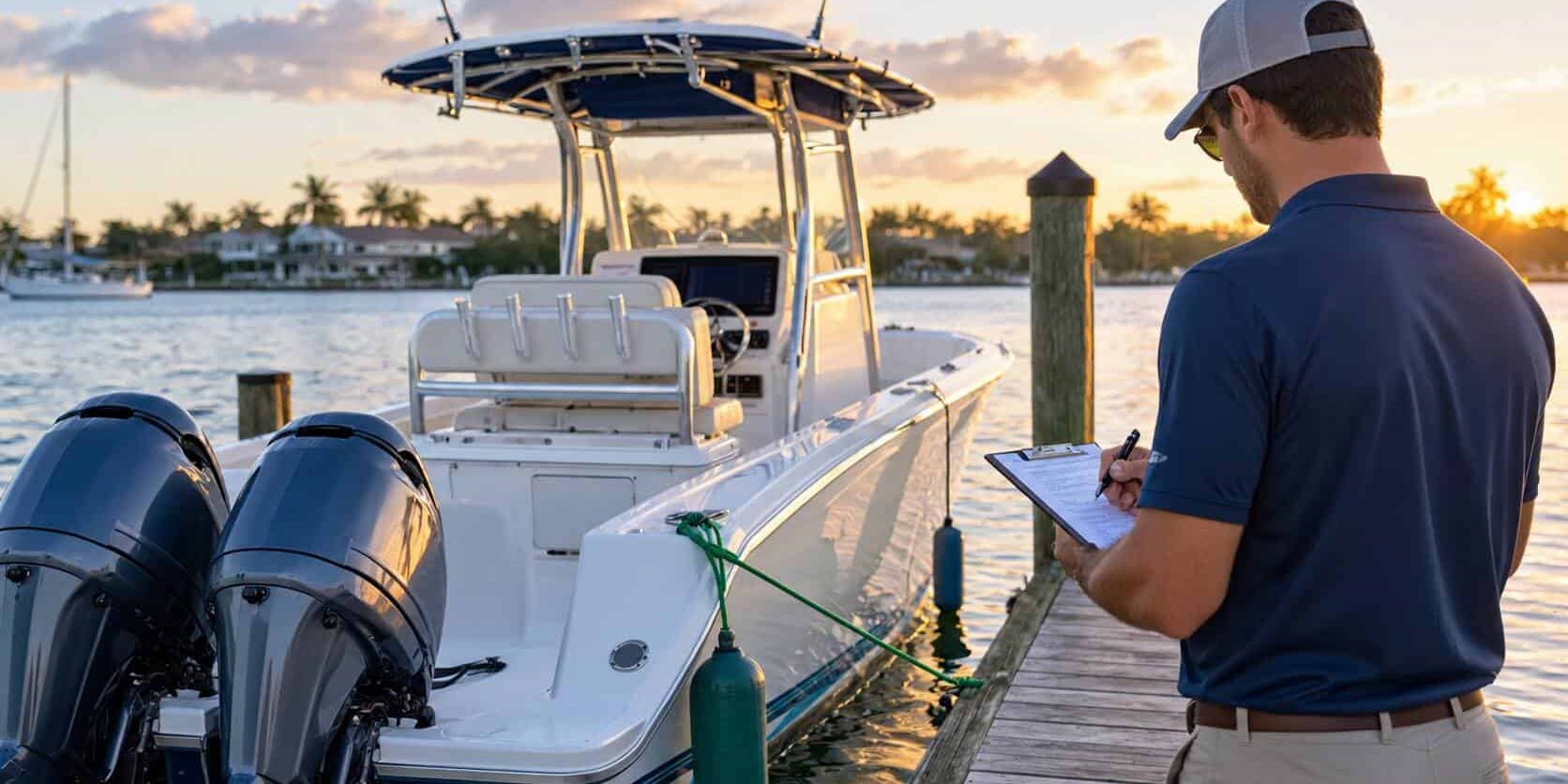
What is my boat worth, and how do brokers work it out?
The honest answer to what is my boat worth: whatever boats like yours have actually closed at recently, adjusted for engines, hours, condition, equipment and history. Asking prices and online guides only give you a starting range. On a 34 foot cruiser, asking and closing prices for the same model year can sit $40,000 apart.
- $40,000Possible gap between asking and sold prices on the same 34 foot cruiser model year.
- 10% to 20%Typical value lost after year one, per J.D. Power, rising to 30% to 40% by year ten.
- $20 to $22 per footTypical cost of a condition and valuation survey, according to BoatUS.
- 2 to 4 monthsTypical time to sell a correctly priced boat under 40 feet on the Treasure Coast.
Most owners who type “what is my boat worth” into Google end up comparing their boat to asking prices on listing sites, and that’s exactly where bad pricing starts. Asking prices show what sellers hope to get. Sold prices show what buyers actually paid, and on a 34 foot cruiser the gap between the two can reach $40,000 for the same model year. Here’s how our brokers at Manatee Pocket Yacht Sales in Stuart, Florida work out a real number, and how you can check yours before you list.
Key Takeaways
- A boat is worth what comparable boats recently closed at, not what similar boats are listed for. On one 34 foot cruiser model year, asking and sold prices can sit $40,000 apart.
- Online guides from J.D. Power (the old NADA guide) give a useful starting range, but they can’t see your engines, hours, upkeep or hull history.
- J.D. Power puts typical depreciation at 10% to 20% after one year and 30% to 40% after ten years. After that, condition matters more than age.
- Engines, condition, records, equipment, hull history and timing decide your boat’s value within that range.
- A broker valuation from sold data is free with us. A condition and valuation survey runs about $20 to $22 per foot, according to BoatUS.
What Is My Boat Worth? The Short Answer
Your boat is worth what a qualified buyer will pay for it right now, and the best evidence of that number is what boats of the same make, model, year and power package actually closed at over the last 12 to 24 months. Asking prices and online guides are starting points for working out how much your boat is worth, not answers.
Brokers call those closed sales “sold comparables,” or comps. A good valuation takes the comps, throws out the ones that don’t truly match, and adjusts the rest for what makes your boat different: engine hours, condition, equipment and history.
Picture a 2016 30 foot center console with twin 300s and 900 hours. Say the last four similar boats closed between $118,000 and $134,000 (illustrative numbers, not a real report). The cheapest still had original engines with 1,800 hours, and the most expensive had a recent repower and new electronics.
What your boat is worth lands inside that band, depending on where it sits on those details. That’s also why a real valuation comes back as a range rather than one figure. We usually give owners three numbers:
- List price: where to start so the boat shows up in the right searches and leaves room to negotiate.
- Expected sale range: where comparable boats have actually closed.
- Walk away floor: the lowest offer that still makes sense against the comps and the season.
Why Asking Prices and Online Guides Give You the Wrong Number
Asking prices and online value guides miss for the same reason: neither one measures what a buyer actually paid for a boat in your boat’s condition. Listings reflect seller optimism, and guides average entire model years together. Both help with a ballpark, but neither should set your list price on its own.
Asking Prices Are Hopes, Not Data
Search results on YachtWorld and Boat Trader are full of boats that haven’t sold, and many haven’t sold because they’re priced too high. The longer an overpriced boat sits, the longer it stays in the results. So the boats you see most often are frequently the ones buyers keep passing over.
When we pull sold comparables for a new listing, this pattern shows up constantly. The same model year advertised at one price closed for noticeably less, and on a 34 foot cruiser that spread can be $40,000. That spread is exactly where boats sit unsold for 18 months.
What J.D. Power and BUC Guides Get Right and Wrong
J.D. Power’s boat values (the guide many people still call NADA) and the BUC Used Boat Price Guide build their numbers from model year data. They’re quick and cheap, and lenders and insurers often reference them, which makes them a fair first look for common production boats.
Their weak spot is everything that makes your boat’s value different from the average. A guide can’t see that your outboards were replaced two years ago, that the hull sat in the Indian River without a lift, or that your electronics are a decade old. BoatUS ran into exactly this in its own valuation test, where a value guide didn’t account for a boat’s newer replacement outboards.
Why Sold Data Wins
SoldBoats.com is a subscription database connected to YachtWorld that records the closing prices brokers report after a sale. Brokers and surveyors can access it, the public can’t, and it’s the backbone of every boat valuation we do.
It has limits, and you should know them. SoldBoats mostly captures broker sales rather than private deals, and it doesn’t grade condition, so two boats with the same sold price could be very different boats. That’s why the adjustment step matters as much as the data itself.
For a feel of how real closings compare with listings, look through the boats we have recently sold and notice how wide the range is even within one category.
How Brokers Actually Value a Boat in 6 Steps
A broker values a boat in six steps: identify the boat exactly, pull sold comparables, filter them down to true matches, adjust for engines and condition, check the live competition and set a price that fits the season. The work usually takes a day or two and ends with a range, not a single number.
- Identify the boat exactly. We start with the hull identification number (HIN), model year, layout and power package, plus engine make, model, serial numbers and hours. A Grady-White Canyon 336 and an Express 330 share a builder and a length, but not a buyer or a price.
- Pull sold comparables. We search SoldBoats.com for the same model, usually two model years either side and the last 12 to 24 months of closings. Popular models give us a dozen or more comps. Rare ones may give us three.
- Filter to true matches. We set aside different engine packages, freshwater boats, distressed sales and obvious outliers. A boat that sold as a project after a storm says nothing about a clean example kept on a lift.
- Adjust for what makes your boat different. Engine hours, a repower, electronics age, canvas and upholstery, gelcoat, bottom condition, service records and any damage history all move the number up or down.
- Check the live competition. We look at every comparable boat on the market today, what it’s asking and how long it’s been listed. If five similar boats are already for sale, your price has to account for them.
- Set the price for the season. A boat priced for October buyers and the same boat listed in June may need different strategies, even though nothing about the boat changed.
Why the Adjustment Step Takes Experience
The adjustment step is where valuations go right or wrong, because no database tells you what a soft deck or a 1,400 hour outboard costs a seller in a real negotiation. Our founder, Tom Whittington, has closed over 1,500 vessels, serves as President of the Marine Industries Association of the Treasure Coast and sits on the board of the Chapman School of Seamanship, and that volume of closings is what turns a list of comps into a defensible number.
Every one of our licensed brokers owns or has run boats on this coast. That matters when the question is how much a buyer will actually knock off for a specific problem.
Which Factors Change a Boat’s Value the Most?
Five factors move a used boat’s value more than anything else: engines and hours, overall condition, maintenance records, equipment and electronics, and hull history. Brand reputation sets the ceiling for a model, but these five decide where your particular boat lands underneath that ceiling.
| Factor | Pushes value up | Pulls value down |
|---|---|---|
| Engines and hours | Recent repower, hours in line with age, warranty left | High hours, overdue service, tired original engines |
| Condition | Clean gelcoat, dry deck, fresh bottom paint | Soft spots, blisters, oxidation, deferred maintenance |
| Records | Service invoices, past surveys, owner’s log | No paperwork, gaps in service history |
| Equipment | Current electronics, working systems, good canvas | Dead screens, failed pumps, torn upholstery |
| Hull history | Kept on a lift, clean insurance record | Storm or sinking history, years unused in the water |
Engines and Hours
Power is the single biggest swing in boat value on most outboard boats. A rule of thumb many buyers use is about 100 hours a year as normal use. A five year old boat with 500 hours reads as normal, while 1,500 hours makes buyers ask hard questions before they make an offer.
Repowers are trickier than owners expect. New engines rarely add their full cost back to the price, but they widen the buyer pool and shorten time on the market. On an older hull with tired engines, a repower can be the difference between selling and sitting.
Condition and Maintenance Records
Condition is what buyers feel in the first five minutes aboard. On sea trials out of the St. Lucie Inlet, our brokers see buyers make up their minds early, and a clean, dry, well documented boat earns a stronger offer than a nicer model that looks neglected.
A binder of service invoices is one of the cheapest value boosts there is. It answers the surveyor’s questions before the surveyor asks them.
Equipment and Electronics
Electronics age fast. A chartplotter that was top of the line eight years ago adds little today, so don’t count its original cost when you work out value. Working systems matter more than fancy ones, and a buyer forgives older screens far more easily than a dead bilge pump.
Hull and Storm History
Hull history follows a boat around. Moisture in the deck core, blistering and any record of storm damage or an insurance total loss will surface during a survey, and buyers discount for them heavily.
If you’d like to see how a broker would weigh all of this on your boat, our valuations and closing support start with a free conversation.
How Much Do Boats Depreciate Each Year?
According to J.D. Power, most used boats lose about 10% to 20% of their value after one year, 20% to 30% after five years and 30% to 40% after ten years. After roughly year ten, depreciation slows down, and the boat’s condition and maintenance history matter more than its age.
Those figures come from J.D. Power’s guide to boat values, and they’re averages across many boat types. Your boat can run faster or slower than the curve.
| Boat age | Typical value lost (J.D. Power) | What drives it |
|---|---|---|
| 1 year | 10% to 20% | The new boat premium disappears |
| 5 years | 20% to 30% | Engine hours and electronics show their age |
| 10 years | 30% to 40% | Condition and upkeep take over |
| Over 10 years | Slows down | Maintenance, repower status, hull history |
Depreciation, and so boat value, is also uneven between boat types. J.D. Power’s 2023 marine market report found used outboard boats from the latest ten model years were about 2.7% lower than a year earlier, while stern drives were about 17.4% lower over the same period.
In our experience, popular saltwater outboard boats in good condition tend to sit at the gentler end of the curve. Niche boats and dated designs fall faster because fewer buyers are looking for them.
Appraisal, Survey or Broker Valuation: Which Do You Need?
Use a free broker valuation when you’re deciding whether and how to sell, a condition and valuation survey when you’re buying or a lender or insurer asks for one, and a formal appraisal when a court, estate or tax filing needs a defensible document. Each one answers a different question and costs a different amount.
| Option | Best for | Typical cost | Who does it |
|---|---|---|---|
| Broker valuation | Pricing a boat to sell | Free with us | Licensed yacht broker |
| Condition and valuation (C&V) survey | Buying, financing, insurance | About $20 to $22 per foot (BoatUS) | SAMS or NAMS accredited surveyor |
| Formal appraisal | Estates, divorce, donations, legal disputes | Varies by scope | Credentialed appraiser or surveyor |
According to BoatUS advice from an accredited marine surveyor, many insurance companies and banks require a condition and valuation survey before they’ll cover or finance a boat, and prices generally run around $20 to $22 per foot. For a 30 foot boat, that’s roughly $600 to $660 before haul out fees.
We can point you to accredited surveyors and service partners we work with on this coast. If you’re on the buying side, the survey value also feeds into boat financing in Florida, since lenders typically want to see it before they approve a loan.
Owners also use our broker valuations for insurance, estate and divorce purposes, and we always show the comparable sales behind the figure. If a court or a tax filing needs a formal appraisal, a credentialed appraiser is the right call, and we’ll tell you so.
What Is My Boat Worth in Florida? Treasure Coast Factors
In Florida, and especially on the Treasure Coast, your boat’s value depends on saltwater exposure, how it’s stored, its storm history and when you sell. Buyers pay more for boats kept on lifts with clean records, and they arrive in force from October through the Stuart Boat Show in January and into spring.
Your Buyer Probably Isn’t Local
The buyer for a boat in Stuart is often not in Stuart. On the higher end, buyers are as likely to be in the Northeast, the Midwest or overseas, so your boat’s value is set by the national market for that model rather than by what a neighbor’s boat sold for.
A pattern we see with out of state buyers every season: they study sold data and survey reports remotely, then fly in for the sea trial. Clean paperwork and honest photos matter more to them than to a local buyer who can walk the dock on a Saturday.
Season Changes the Math
A boat listed in June competes for a much smaller audience than one listed in October, so a summer valuation of your boat’s worth has to factor in more time on the market.
On the Treasure Coast, a correctly priced boat under 40 feet typically sells in two to four months. Larger boats and specialist sailboats take longer because the buyer pool is smaller.
Storage, Salt and Storms
Boats kept on a lift or in dry storage usually look better under the waterline than boats left in the water year round. Hurricane season runs from June 1 to November 30, according to the NOAA National Hurricane Center, and storm damage or an insurance claim tends to come up at survey, so disclose it early and price it in.
To see how comparable boats are presented and priced right now, browse boats for sale in our current inventory and compare the details as well as the prices.
Self Check: Estimate Your Boat’s Value Before You Call Anyone
You can get a realistic range for what your boat is worth in about 20 minutes with your paperwork and an honest eye. This checklist won’t replace sold data, but it tells you whether the number in your head holds up before you talk to a broker or a buyer.
- Write down the exact make, model, model year and HIN.
- Record engine make, model, horsepower, serial numbers and current hours.
- Gather service records, past surveys and any repower or warranty paperwork.
- Look up your model in J.D. Power and note the low and average retail figures.
- Find three to five similar boats for sale and note how long each has been listed.
- Subtract the cost of anything broken, overdue or obviously worn.
- Be honest about hull history: storms, groundings, sinkings and insurance claims.
- Check the calendar. Listing between October and spring helps, and a June listing needs more patience.
- Compare your number with a broker’s figure from sold data, and ask to see the comps.
If you’re unsure what a survey will dig into, our brokerage FAQ covers surveys, closings and paperwork in plain language.
Common Mistakes That Cost Boat Sellers Money
The costliest valuation mistakes are pricing from asking prices, counting upgrades dollar for dollar, ignoring the season and waiting too long to adjust. Each one inflates or ignores part of a boat’s value and keeps it on the market longer. A boat that goes stale usually sells for less than a realistic price would have brought on day one.
- Pricing off listings instead of sales. Asking prices include every overpriced boat that never sold.
- Counting upgrades at full cost. A $25,000 electronics package doesn’t add $25,000 to the price, and buyers know it.
- Paying for major mechanical work right before listing. A deep clean, bottom paint if it’s due and working electronics usually return more than they cost. Major mechanical work rarely does, because buyers discount for it either way and the survey will find it.
- Chasing the highest broker quote. A pattern we see on listings that come to us after a year with another broker: the boat was priced high to win the listing, then sat. We’d rather lose a listing than take one at a price we know won’t sell.
- Hiding known problems. Buyers and surveyors find them anyway, usually at the worst moment in the deal.
- Waiting too long to adjust. In our experience, if a boat gets plenty of online views but no showings in the first 30 to 45 days, price is usually the problem.
When You May Not Need a Broker’s Valuation
A broker valuation isn’t always worth your time. If you own a small, common trailer boat worth a modest amount, an online guide plus a few local sold examples can get you close, and a private sale may net you more because commission would eat much of what a broker adds.
The same goes for owners who are happy to handle showings, screen buyers, run sea trials and manage the title and documentation paperwork themselves.
A broker earns the fee on larger, higher value boats, out of state buyers and boats with complicated histories. If none of that describes you, an honest guide and some homework may tell you what your boat is worth well enough.
Get a Real Number for Your Boat This Week
The fastest reliable answer to what is my boat worth comes from a licensed broker pulling sold comparables for your exact boat and adjusting them honestly. That takes us a day or two, costs nothing, and gives you a list price, an expected sale range and a realistic timeline for the season.
Tell us about your boat and we’ll send you a free boat valuation built from real sold data, with the comparable sales it came from. There’s no listing fee and no obligation, so call 772-600-8535 or stop by 4905 SE Dixie Highway in Stuart if you’d rather talk it through in person.
Frequently Asked Questions
How do I find out what my boat is worth?
Start with your boat’s exact make, model, year, engines and hours, then compare it with what similar boats have actually sold for, not what they’re listed at. Online guides from J.D. Power give a starting range. For a reliable number, ask a licensed broker to pull sold comparables from SoldBoats.com and adjust them for your boat’s condition.
Are NADA boat values accurate?
NADA boat values, now published by J.D. Power, are a reasonable starting point for common production boats. They average whole model years, so they can’t account for your engine hours, a repower, upgrades or hull history. Treat them as a ballpark and confirm the number with sold data.
How much does a boat depreciate per year?
According to J.D. Power, most used boats lose about 10% to 20% of their value after the first year, 20% to 30% after five years and 30% to 40% after ten years. After about year ten, condition and maintenance history matter more than age.
Does a repower increase a boat’s value?
A repower usually raises a boat’s value and makes it easier to sell, but it rarely adds back the full cost of the new engines. The biggest benefits are a wider buyer pool and less time on the market, especially on an older hull whose original engines have high hours.
Should I get a survey before I sell my boat?
Most sellers don’t need one, because the buyer normally orders and pays for the survey. A survey before listing can make sense on an older or higher value boat if you want to find surprises before a buyer does. Either way, fix cheap, visible items first and disclose anything you already know about.
If you’d rather talk it through face to face, visit our Stuart office or call 772-600-8535 for a free valuation.

Tom Whittington
Founder
Manatee Pocket Yacht Sales
Written by our team of licensed Florida yacht brokers · Stuart, Florida · Since 2010
Manatee Pocket Yacht Sales is a licensed Florida yacht brokerage in Stuart, founded by Tom Whittington in 2010. Our ten brokers have closed more than 2,000 boats, including yachts to 76 feet, for owners on the Treasure Coast, across the United States and overseas. We bring pricing from real sold data and buyers screened before they ever step aboard.






Licensed brokers and captains who own and run boats on this coast. Meet the team
- Boat Listing and Selling
- Free Buyer’s Brokerage
- Valuations from Sold Data
- Closing and Documentation
- 2026 Treasure Coast Community’s Choice Awards