
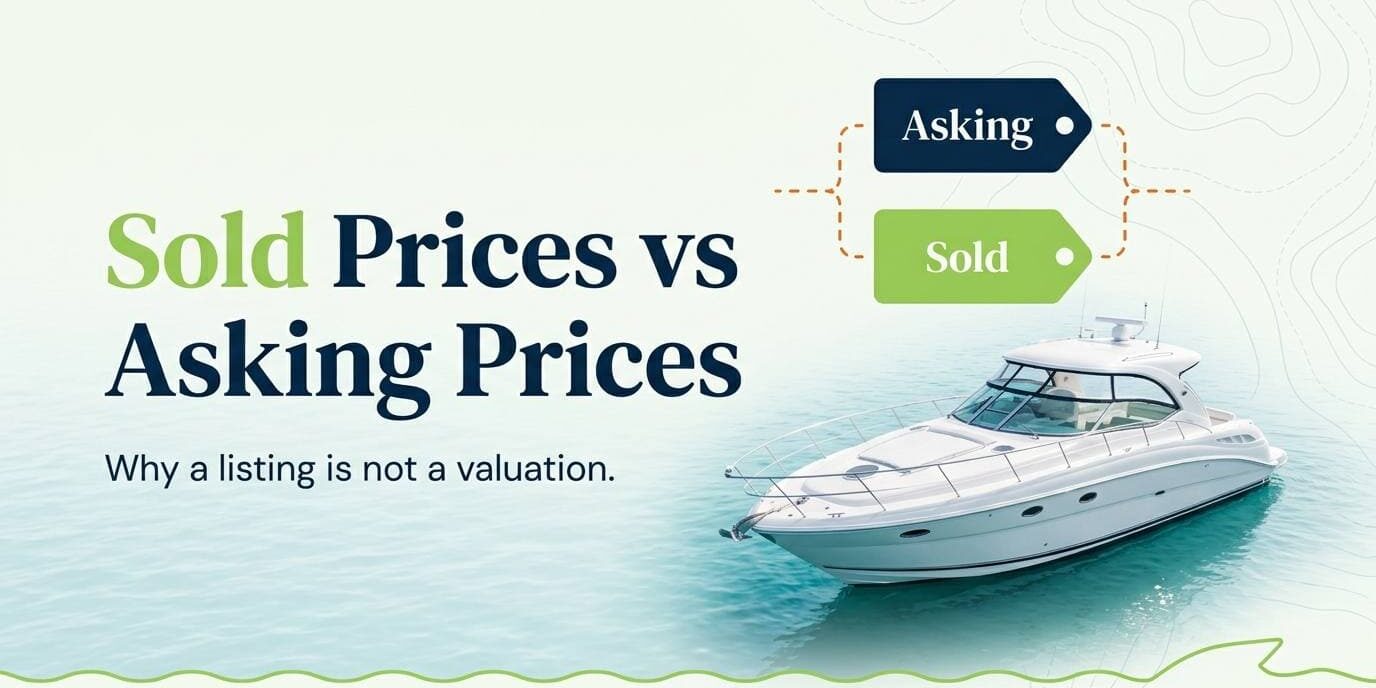
Is a boat’s asking price what it’s actually worth?
No. An asking price is what a seller hopes to get, while boat sold prices are what buyers actually paid at closing. Brokers pull those closings from SoldBoats.com, a database the public can’t search. On a 34 foot cruiser, asking and closing prices for the same model year can sit $40,000 apart.
- $40,000The spread we see between asking and closing prices on a 34 foot cruiser of the same model year.
- Up to 18 monthsHow long boats priced inside that spread can sit unsold.
- 2 to 4 monthsTypical time to sell a correctly priced boat under 40 feet on the Treasure Coast.
- 91%Share of boats sold globally in August 2026 that were used, per Boats Group data reported by YBAA.
Most owners price their boat by searching YachtWorld for the same model and picking a number near the top of the page. The trouble is that asking prices only show what sellers hope for, while boat sold prices show what buyers actually paid, and on a 34 foot cruiser those two numbers can sit $40,000 apart for the same model year. That gap is exactly where Treasure Coast listings stall for 18 months, and it’s the first thing our brokers in Stuart, Florida check before we put a number on any boat.
Key Takeaways
- An asking price is a seller’s opinion. Boat sold prices are closed deals, and only closed deals tell you what a boat is worth.
- Brokers pull sold prices from SoldBoats.com, the industry closing database that the public can’t access.
- On a 34 foot cruiser we see a $40,000 spread between asking and closing prices for the same model year, and boats priced inside that spread can sit unsold for 18 months.
- Listing searches skew high because the well priced boats already sold. What’s left online is mostly what didn’t.
- A correctly priced boat under 40 feet typically sells in two to four months on the Treasure Coast, with buyers arriving from October through spring.
What are boat sold prices, and how are they different from asking prices?
Boat sold prices are the amounts buyers actually paid when a deal closed, after the sea trial, the survey and any renegotiation. An asking price is the number a seller or listing broker puts on the ad before any buyer has agreed to anything. One is a fact about the market. The other is an opinion about one boat.
A single boat really carries four different prices on its way to a new owner, and owners mix them up all the time.
| Price | Who sets it | When | What it tells you |
|---|---|---|---|
| Asking price | Seller and listing broker | Before any buyer shows up | What the seller hopes for |
| Offer price | One buyer | After a showing, before survey | What one buyer will risk |
| Sold price | Buyer and seller, recorded at closing | After sea trial and survey | What the market actually paid |
| Net to seller | Closing math | At funding | Sold price minus commission and any agreed credits |
Only the highlighted row belongs in a valuation. Everything above it is a guess, and the row below it is arithmetic.
Why is an asking price not a valuation?
An asking price isn’t a valuation because nothing has tested it. No buyer agreed to it, no surveyor inspected the boat behind it, and no closing agent recorded it. Asking prices also copy each other: owners match the highest similar listing, which matched another listing, until the whole search page floats above what boats really close at.
Listing searches show the boats that didn’t sell
Here’s the part most owners miss. A search on YachtWorld or Boat Trader today shows boats that are still for sale, and correctly priced boats usually leave within a few months. What stays behind skews toward boats priced above the market, so a listing search is a survivor list, not a price list.
Why a listing search always looks expensive
The same set of comparable listings, at launch and six months later
Month 1: every listing
Month 6: what an owner sees online
Where most asking prices really come from
When we ask owners how they arrived at their number, the answers rarely involve a closing. The usual sources look like this:
- What the owner paid, plus the cost of upgrades added dollar for dollar.
- The loan payoff, because nobody wants to bring a check to closing.
- The highest similar listing online, often one that has sat for a year.
- A broker who quoted a high number to win the listing.
Where do brokers find boat sold prices?
Brokers find boat sold prices in SoldBoats.com, the industry database where YachtWorld member brokerages report what boats closed at. The public can’t search it. A typical record shows the asking price, the sold price, the listing and sale dates, the engines and the hours, so a broker can compare a boat with genuinely similar closings.
Soundings Trade Only, which has reported on SoldBoats.com figures for years, describes the data as unaudited and voluntarily supplied by member brokers. That’s why a single comparable never sets a price on its own. A cluster of five to ten similar closings does.
| Source | What it measures | Public? | Best used for |
|---|---|---|---|
| YachtWorld and Boat Trader listings | Asking prices today | Yes | Seeing your competition |
| NADA guides (J.D. Power) | Model year averages | Yes | A rough starting range |
| SoldBoats.com | Reported closing prices | No, brokers and surveyors | Setting a real price |
| Marine survey or appraisal | One boat’s condition and value | Ordered per boat | Lenders, insurers and the final deal |
Price guides have their place, but they can’t see engine hours, a repower or storm history, which is why NADA values miss on individual boats so often. Our founder Tom Whittington has closed over 1,500 vessels, serves as President of the Marine Industries Association of the Treasure Coast and sits on the board of the Chapman School of Seamanship, and every price our ten Stuart brokers set starts from closing data rather than hope. If you want the full method, our guide to how brokers value a boat walks through it from start to finish.
How big is the gap between asking and sold prices?
The gap between asking and sold prices depends on age, condition, season and how long a boat has been listed. On a 34 foot cruiser we can see a $40,000 spread between asking and closing prices for the same model year. Fresh, correctly priced boats in popular models close much nearer their asking price than tired listings do.
The $40,000 spread on a 34 foot cruiser
Same model year, asking prices online vs reported closing prices
What widens the gap
- Days on market. Once a listing passes nine months, offers get measured against how long it has sat, not against the boat.
- Age. On older boats, buyers price in the repower, the canvas and the electronics they expect to replace.
- Survey findings. Soft decks, moisture and engine issues turn into credits after the survey, and the closing price records that.
- Season. A boat listed in June competes for a much smaller audience than one listed in October.
- Rare models. With only two or three closings to compare, asking prices drift further from reality.
As a rough range rather than a rule, the gap runs from a few percent on a fresh, well priced boat in a popular model to 15% or more on listings that have sat through a season. The used market is busy right now, which makes accurate pricing matter more, not less. Boats Group figures reported by the Yacht Brokers Association of America show used boats made up 85% of boats sold globally in June 2026, 87% in July and 91% in August, with North American sales up 19.2% year over year in July.
Share of boats sold globally that were used, by month
- 85%June 2026
- 87%July 2026
- 91%August 2026
How do you read sold comparables the right way?
Read sold comparables by matching the boat first and the price second. Filter for the same make and model within two model years, then adjust for engines, hours, repowers, equipment, condition and where the boat sold. A closing from 18 months ago in a different season deserves less weight than one from last quarter.
- Match make, model and LOA within two model years. A 2016 and a 2019 of the same hull can close far apart once engines and electronics change.
- Compare power and hours. Twin 300s with 1,100 hours and a fresh repower are different boats on paper, even with the same hull.
- Weight recent sales. The last 12 to 24 months matter most, because rates, fuel prices and buyer demand move.
- Check where and how the boat lived. A hull that sat in the Indian River all year shows it differently from one kept on a lift under cover.
- Read the days on market. A comparable that closed after 400 days tells you its asking price was wrong.
- Look past the asking price on the record. The closing figure already includes the survey renegotiation, which is the number that counts.
Every one of those adjustments has its own logic, and our breakdown of six factors that move price covers each one in more depth.
What happens when you price a boat off asking prices instead of sold prices?
Pricing off asking prices usually means listing above the market, getting showings but no offers, then cutting the price in steps after the season’s best buyers have moved on. The boat often closes near or below what sold data suggested at the start, only a year or more later and after extra slip, insurance and upkeep costs.
An illustrative 18 month listing
Picture a 34 foot cruiser listed in June at the top of the asking price range, $40,000 above where similar boats have closed.
- Months 1 to 3. Summer brings a few lookers and no offers. Out of state buyers haven’t started their search yet.
- Months 4 to 7. Snowbird season arrives, but buyers compare against recent closings and buy the boats priced near them.
- Month 8. The first price cut lands, and the boat is now “the one that’s been sitting.”
- Months 12 to 18. More cuts follow, and offers come in measured against how long it has been listed, not against the boat.
The Treasure Coast selling season
Buyer activity pattern our brokers see through the year
Buyers arrive with the snowbirds from October, and the market stays busy through the Stuart Boat Show in January and into spring. A correctly priced boat under 40 feet typically sells in two to four months on the Treasure Coast. Larger boats and specialist sailboats take longer because the buyer pool is smaller, and on the higher end that buyer is as likely to be in the Northeast, the Midwest or overseas as in Stuart.
If you want to see where your boat actually sits against sold data, start with the boats we’ve closed recently, then ask us to run your comparables for free.
How should buyers use boat sold prices?
Buyers should use boat sold prices to set an offer range before falling for a boat, not after. If comparable boats closed well under a listing’s asking price, that asking price is only a starting point. If the boat is fresh, correctly priced and in season, a lowball offer usually just hands it to the next buyer.
You can’t search SoldBoats.com yourself, but a broker can pull the comparables for you. On a brokerage sale the seller pays the commission, so our free buyer’s broker service costs you nothing, and we know which boats have been sitting and which ones to walk away from.
The survey is where the final number moves most, and our survey and closing questions answered page covers deposits, escrow and how renegotiation works.
When don’t you need a broker’s sold data?
You may not need a broker’s sold data for a small, low value boat where commission would eat most of the margin, or if you can handle showings, buyer screening and paperwork yourself. A trailer boat with dozens of identical models listed nearby often sells fine privately with a sensible price, good photos and a clean title.
Sold data also matters outside a sale. We prepare valuations for insurance, estate and divorce purposes too, and we always show the comparable sales the number came from.
Pricing mistakes we see on boats that won’t sell
The most common pricing mistakes all come back to trusting asking prices over boat sold prices. Each one below adds months to a listing, and most of them are free to fix before the boat goes live.
- Copying the highest listing. That listing is probably still for sale for a reason.
- Adding upgrades dollar for dollar. Buyers pay for condition, not receipts.
- Pricing to the loan payoff. The market doesn’t know or care what you owe.
- Paying for major mechanical work first. Buyers discount for it either way and the survey will find it. A deep clean, bottom paint if due and working electronics usually return more than they cost.
- Listing in June at a January price. The audience is smaller and the stale clock starts early.
- Trusting one comparable. A single closing can hide a desperate seller or a boat in rare condition.
Get a price built on boat sold prices, not hope
An asking price tells you what someone wants. Boat sold prices tell you what the market will pay, and that difference decides whether your boat sells this season or sits until the next one.
Send us your boat’s make, model, year, engines and hours, and we’ll run a free boat valuation from SoldBoats.com closing data, with every comparable shown so you can check our math. Sellers pay nothing until they accept an offer, and if the number isn’t what you hoped, we’ll tell you honestly whether the issue is price, condition or timing.
Frequently Asked Questions
What is the difference between a boat’s asking price and its sold price?
The asking price is what the seller lists the boat for before any buyer agrees to anything. The sold price is what a buyer actually paid at closing, after the sea trial, survey and any renegotiation. Only the sold price reflects what the market will pay.
How can I find out what a boat sold for?
Most reported boat sold prices live in SoldBoats.com, a database for brokers and surveyors that the public can’t search. Ask a licensed yacht broker to pull the comparable closings for your make, model and year. A good broker will show you the actual records, not just a number.
How much below asking price do boats usually sell?
It depends on age, condition, season and days on market. Fresh, correctly priced boats in popular models close near their asking price, while stale listings close well below it. On a 34 foot cruiser we see a $40,000 spread between asking and closing prices for the same model year.
Is SoldBoats.com accurate?
SoldBoats.com is the best sold data the industry has, but it relies on brokers reporting their own sales and doesn’t capture most private deals. It’s most reliable when five to ten similar boats have closed recently. For rare models, a broker has to add judgment on top of the data.
How long does it take to sell a correctly priced boat on the Treasure Coast?
A correctly priced boat under 40 feet typically sells in two to four months on the Treasure Coast. Larger boats and specialist sailboats take longer because fewer buyers are shopping for them. Listing between October and spring puts your boat in front of the most buyers.
Want to know what boats like yours really closed at? Talk to a Stuart broker and we’ll pull the comparables for you.

Tom Whittington
Founder
Manatee Pocket Yacht Sales
Written by our team of licensed Florida yacht brokers · Stuart, Florida · Since 2010
Manatee Pocket Yacht Sales is a licensed Florida yacht brokerage in Stuart, founded by Tom Whittington in 2010. Our ten brokers have closed more than 2,000 boats, including yachts to 76 feet, for owners on the Treasure Coast, across the United States and overseas. We are strictly brokerage: no new boat stock and no showroom inventory competing with your listing, just pricing from real sold data and buyers screened before they ever step aboard.






Licensed brokers and captains who own and run boats on this coast. Meet the team
- Boat Listing and Selling
- Free Buyer’s Brokerage
- Valuations from Sold Data
- Closing and Documentation
- 2026 Treasure Coast Community’s Choice Awards