
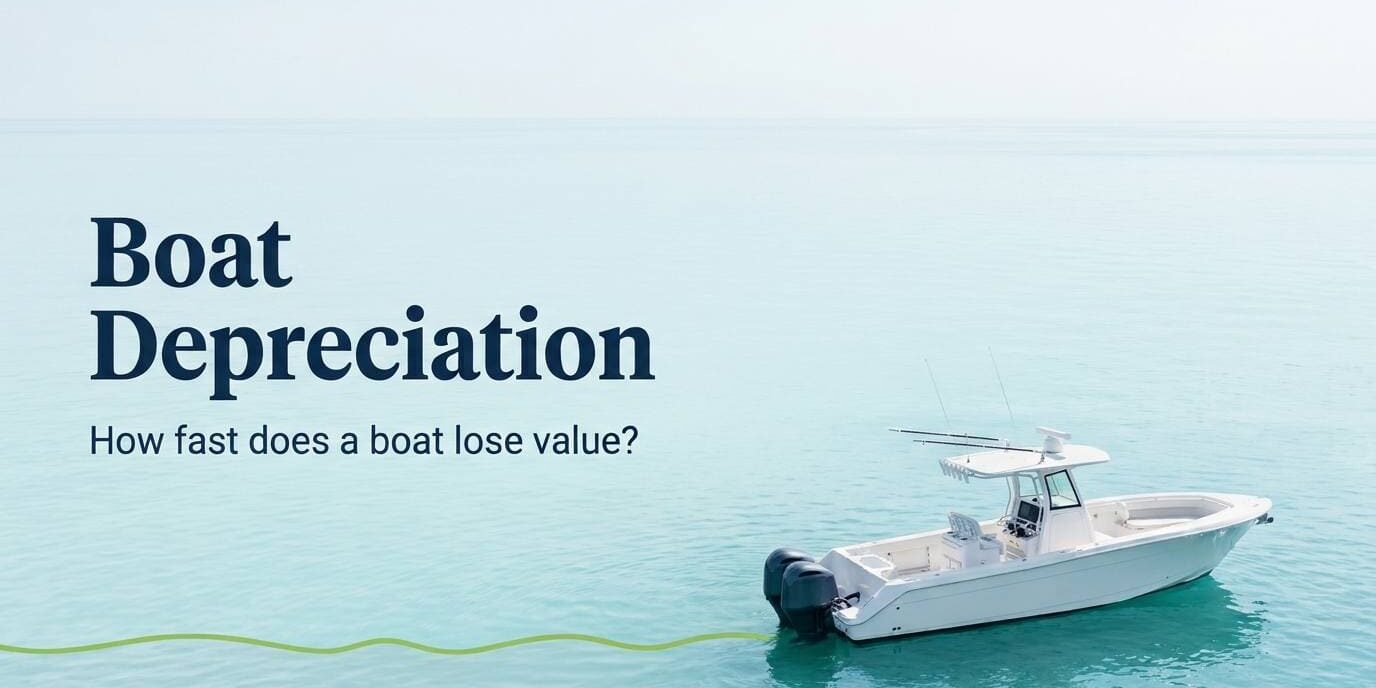
How fast does a boat lose value?
Boat depreciation is steepest early. J.D. Power estimates most boats lose 10% to 20% of their value after one year, 20% to 30% after five years and 30% to 40% after ten. After about year ten the curve flattens, and condition, engine hours and maintenance records matter more than age.
- 10% to 20%Typical value a boat loses after its first year, per J.D. Power.
- 30% to 40%Typical value lost by year ten, after which the curve flattens.
- 3 to 5 years oldThe age range where a used buyer lets the first owner absorb the steepest drop.
- 2 to 4 monthsTypical time to sell a correctly priced boat under 40 feet on the Treasure Coast.
Most owners find out what boat depreciation did to them on the day they ask what their boat is worth, not the day they buy it. J.D. Power estimates most boats lose 10% to 20% of their value after one year and 30% to 40% by year ten, but those averages hide a huge difference between a well kept center console and a neglected express cruiser. Here’s how fast boats really lose value, which ones hold it, and the parts of the curve you actually control.
Key Takeaways
- J.D. Power estimates boats lose 10% to 20% of their value after one year, 20% to 30% after five years and 30% to 40% after ten.
- The first owner absorbs the steepest drop. Buying a boat that’s three to five years old lets someone else take that hit.
- After about year ten, condition, engine hours, repowers and service records drive value far more than age does.
- Boats with big buyer pools, like popular center consoles from strong builders, tend to hold value better than large express cruisers and motor yachts.
- Real depreciation is measured against what similar boats closed at, not against asking prices online.
How fast does a boat lose value?
A boat loses value fastest in its first few years. J.D. Power estimates typical boat depreciation at 10% to 20% after one year, 20% to 30% after five years and 30% to 40% after ten years. Beyond year ten the decline slows sharply, and a boat’s condition and maintenance history set its price more than its age.
Those ranges describe an average boat on an average curve. The individual boat on your trailer or lift can sit well above or below that band, and that’s where most of the money is.
The boat depreciation curve
Share of original value retained, by age
| Boat age | Typical value lost | Value retained | What sets the price |
|---|---|---|---|
| After 1 year | 10% to 20% | 80% to 90% | Model year and new boat discounts |
| After 5 years | 20% to 30% | 70% to 80% | Hours, equipment and demand |
| After 10 years | 30% to 40% | 60% to 70% | Condition, engines and records |
| Beyond 10 years | Slows sharply | Varies widely | Condition and maintenance, almost entirely |
What that means for a $200,000 boat
Illustrative value over time using the J.D. Power ranges
- New$200,000
- After 1 year$160,000 to $180,000
- After 5 years$140,000 to $160,000
- After 10 years$120,000 to $140,000
For the full method our brokers use to turn that curve into a number for one specific boat, read our guide to how brokers value a boat.
Why do boats depreciate fastest in the first year?
Boats depreciate fastest in year one because a new boat’s price includes things the next buyer won’t pay for: dealer margin, freight and prep, and the premium for being first. Once the next model year arrives, a one year old boat competes with every other used boat of its year, and buyers price it that way.
Model years matter more than most new boat buyers expect. BoatUS Consumer Affairs makes the point in its guide to what dealers don’t have to tell you: a leftover new boat bought at a discount still depreciates to its model year value, so it ends up worth the same as a used boat of that year.
Here’s the honest brokerage view. Manatee Pocket Yacht Sales is a brokerage, not a dealership, so we have no new boat stock to move and no reason to steer you toward the steepest part of the curve. If you love a specific new model and plan to keep it for a decade, buying new can make sense. If resale matters to you, a boat that’s three to five years old usually gives you most of the boat for a lot less of the drop.
Do boats hold their value? Which ones hold it best?
Some boats hold value far better than the average curve suggests. Boats with large buyer pools, strong builders and easy repowers, like popular center consoles and walkarounds, tend to depreciate more slowly. Large express cruisers and motor yachts usually lose value faster, because fewer buyers can afford their running costs and their styling dates sooner.
| Boat type | Tends to hold value | Why |
|---|---|---|
| Center consoles and walkarounds | Better than average | Huge buyer pool, outboards that can be repowered, year round fishing demand |
| Sportfish and convertibles | Strong for top builders, wider spread for others | Brand reputation and engine hours dominate the price |
| Downeast boats and trawlers | Steady, but slower to sell | Smaller, loyal buyer pool that pays for condition |
| Sailboats | Steady when well kept | Specialist buyers who price sails, rigging and engine hours |
| Large express cruisers and motor yachts | Faster than average | Fewer buyers, higher running costs, dated styling |
Brand matters too. Builders like Grady-White, Albury Brothers, Regulator, Viking and Boston Whaler come through our listings constantly, and their resale strength is a big part of why buyers ask for them by name.
What makes one boat depreciate faster than another?
A boat depreciates faster when its engines are tired, its records are missing, it lives in the water without care, or it carries storm history. Saltwater and the Florida sun add their own wear to gelcoat, canvas, upholstery and electronics. Each of those factors shows up on survey, and buyers deduct for every one.
What moves a boat off the average curve
The same hull can land at the top or bottom of the range
Speeds depreciation up
- High engine hours with no service records
- Kept in the water year round without regular care
- Storm or flood history, or an insurance claim
- Faded gelcoat, tired canvas and dead electronics
- Heavy custom changes few buyers want
- Rare model with a small buyer pool
Slows depreciation down
- A file of service invoices and survey reports
- Lift or dry storage, out of the water
- A recent repower from a known brand
- Bottom paint, canvas and upholstery kept fresh
- Working, current electronics
- Popular builder and layout on this coast
Each of those factors has its own logic for price, and our breakdown of six factors that move price covers them one by one.
How do you work out how much your boat has depreciated?
Work out your boat’s depreciation by comparing what you paid with what similar boats have actually closed at in the last 12 to 24 months, not with asking prices online. Divide the difference by your purchase price. That percentage is your real depreciation, before you adjust for upgrades, hours or condition.
- Start with the price of the boat itself. Leave out sales tax, registration, financing costs and accessories you bought later.
- Pull 3 to 10 sold comparables. Same make and model, within two model years, closed in the last 12 to 24 months.
- Adjust for the boat in front of you. Engine hours, a repower, electronics, storage history and condition all move the number.
- Subtract and divide. Purchase price minus today’s realistic closing value, divided by the purchase price, gives your depreciation rate.
Picture a 2016 30 foot center console with twin 300s and 1,100 hours, bought used in 2021 for $180,000. If similar boats with similar hours have recently closed between $150,000 and $160,000, that owner’s real depreciation is roughly 11% to 17% over five years. The example is illustrative, but the method is exactly the one we use.
Asking prices make this math look better than it is, which is why asking prices mislead owners so often. Our founder Tom Whittington has closed over 1,500 vessels, serves as President of the Marine Industries Association of the Treasure Coast and sits on the board of the Chapman School of Seamanship, and every number our ten Stuart brokers give starts from SoldBoats.com closing data, the industry database of what boats actually sold for.
If you want to see where boats like yours have really landed, browse the boats we’ve closed recently, and we’ll run your comparables for free.
How can you slow boat depreciation?
You slow boat depreciation by keeping records, keeping the boat out of the water when you can, servicing engines on schedule and fixing small problems before a surveyor finds them. None of that stops the curve, but it moves your boat toward the top of its range, which on a $200,000 boat can be a $20,000 difference.
Six habits, ranked by impact
- Keep every invoice and survey. A complete service file is the cheapest value protection there is, and buyers pay for proof.
- Store out of the water when possible. A lift or dry storage spares the hull, running gear and bottom from constant exposure.
- Service and run the engines. Engines that sit suffer. Regular use and scheduled service keep hours honest and surveys clean.
- Keep the surfaces fresh. Bottom paint, gelcoat polish, canvas and upholstery are what buyers see first in listing photos.
- Fix small issues early. A sticky trim tab or a dead pump becomes a negotiation point at survey.
- Skip heavy customization. Your taste in layout rarely matches the next buyer’s.
| Usually pays back | Rarely pays back |
|---|---|
| A deep clean and detail | Major mechanical work right before listing |
| Bottom paint, if it’s due | A repower done only to sell |
| Electronics that all work | Custom upgrades few buyers want |
| An organized service file | Waiting another season for prices to rise |
Major mechanical work rarely pays back because buyers discount for it either way and the survey will find it. For the routine work that does protect value, our list of trusted marine service partners covers yards, mechanics and detailers on this coast.
Is it better to buy new or used because of depreciation?
For most buyers, a used boat that’s three to five years old is the depreciation sweet spot. The first owner has already absorbed the 10% to 20% first year drop, the boat is usually still modern, and the remaining curve is gentler. Buying new makes more sense if you want a specific model and plan to keep it for ten years or longer.
Buying used does shift the risk from depreciation to condition, which is why the survey and sea trial matter so much on a used boat. On a brokerage sale the seller pays the commission, so our free buyer’s broker service costs you nothing, and we know which boats have been sitting and which ones to walk away from.
Age also affects how you pay for the boat. Many marine lenders shorten terms or ask for a survey as boats get older, so check your boat loan options before you settle on a model year.
When should you sell a boat to limit depreciation?
Sell before a major cost comes due, like a repower, a bottom job or new canvas, and list between October and spring when buyers are here. Every extra year you hold a boat you no longer use adds another year of depreciation plus slip, insurance and maintenance, so waiting for prices to rise usually costs more than it saves.
On the Treasure Coast, buyers arrive with the snowbirds from October, and the market stays busy through the Stuart Boat Show in January and into spring. A correctly priced boat under 40 feet typically sells in two to four months, while a boat listed in June competes for a much smaller audience. Larger boats and specialist sailboats take longer because the buyer pool is smaller, and that buyer is as likely to be in the Northeast, the Midwest or overseas as in Stuart.
Boat depreciation mistakes we see
Most depreciation mistakes come from measuring the loss the wrong way or trying to spend your way out of it. Each one below either makes the loss look worse than it is or makes the actual loss bigger, and every one of them is avoidable.
- Measuring against the wrong starting price. Taxes, fees and accessories aren’t part of the boat’s resale value.
- Measuring against asking prices. Your boat competes with what similar boats closed at, not what they’re listed for.
- Repowering right before a sale. New engines help a boat sell, but buyers rarely pay back the full cost.
- Letting the boat sit unused. Idle engines and systems deteriorate faster than ones that run.
- Losing the paperwork. Without records, buyers assume the worst and price accordingly.
- Pricing to get your money back. The market doesn’t know what you paid, and a listing priced to recover it sits.
Find out what boat depreciation has really done to your boat
Averages tell you how boats in general lose value. Your boat’s real number depends on its engines, records, storage and the closings our brokers can see, and it’s often better than owners fear.
Send us your boat’s make, model, year, engines and hours, and we’ll run a free boat valuation from SoldBoats.com closing data, with every comparable shown. Sellers pay nothing until they accept an offer, and if now isn’t the right time to sell, we’ll tell you that too.
Frequently Asked Questions
How much does a boat depreciate per year?
Most boats lose 10% to 20% of their value in the first year, according to J.D. Power. After that the pace slows, reaching 20% to 30% total by year five and 30% to 40% by year ten. Beyond ten years, condition matters more than age.
Do boats hold their value?
Boats lose value over time, but some hold it far better than average. Popular center consoles and walkarounds from strong builders, with full service records and lift storage, tend to depreciate more slowly. After about ten years, condition sets the price more than age does.
Which boats depreciate the fastest?
Large express cruisers and motor yachts usually lose value fastest, because fewer buyers can afford their running costs and their styling dates quickly. Any boat with high engine hours, missing records or storm history also drops faster than its peers.
Is it smarter to buy a new or used boat because of depreciation?
For most buyers, a used boat three to five years old avoids the steepest part of the curve, since the first owner absorbs the 10% to 20% first year drop. Buying new makes more sense if you want a specific model and plan to keep it for ten years or longer.
When does boat depreciation slow down?
Boat depreciation slows sharply after about ten years, once a boat has typically lost 30% to 40% of its value. From then on, condition, engine hours, repowers and maintenance records set the price far more than the boat’s age.
Want to know where your boat sits on the curve? Talk to a Stuart broker and we’ll pull the closings for you.

Tom Whittington
Founder
Manatee Pocket Yacht Sales
Written by our team of licensed Florida yacht brokers · Stuart, Florida · Since 2010
Manatee Pocket Yacht Sales is a licensed Florida yacht brokerage in Stuart, founded by Tom Whittington in 2010. Our ten brokers have closed more than 2,000 boats, including yachts to 76 feet, for owners on the Treasure Coast, across the United States and overseas. We are strictly brokerage: no new boat stock and no showroom inventory competing with your listing, just pricing from real sold data and buyers screened before they ever step aboard.







Licensed brokers and captains who own and run boats on this coast. Meet the team
- Boat Listing and Selling
- Free Buyer’s Brokerage
- Valuations from Sold Data
- Closing and Documentation
- 2026 Treasure Coast Community’s Choice Awards